You've been to your GP, maybe to a specialist as well. Perhaps they took blood, did an ultrasound scan, or even a colonoscopy. Everything looks “normal”. And then you hear it: you have IBS (irritable bowel syndrome), you'll just have to learn to live with it.
For many people, that moment doesn't feel like relief, but like a door closing. Because the symptoms are still there, only now you've been given a name for them that explains very little.
Want insight into what may lie behind your symptoms, how different factors interact, and the first steps you can take yourself to ease them? Take the free Gut Scan.
What exactly is irritable bowel syndrome?
IBS is not a disease in the traditional sense. It is an umbrella term for a group of symptoms such as abdominal pain, bloating, changing bowel habits and cramps. Doctors make the diagnosis once they have ruled out other conditions. That means IBS only tells you that your gut is irritated, but not yet what is actually going on.
Compare it to a warning light in your car. When something goes wrong, the light comes on. IBS is like that light: it tells you something is wrong, but not what. Some people are told to change their diet (often the low-FODMAP diet) and to reduce their stress. That can ease the symptoms, but it still says nothing about the cause.
What is going on under the surface
In recent years, a lot of research has looked at what actually happens in the gut of people with IBS. And more and more often, that research points in the same direction: the gut microbiome.
Your gut contains millions of bacteria that together form an ecosystem. That ecosystem affects your digestion, your immune system and even your mood. For example, around 95% of the serotonin in your body is produced in your gut. Serotonin plays an important role in how you feel. With a serotonin shortage you can feel low or even depressed. It affects how you sleep, whether you fall asleep easily and sleep through the night. And it plays a role in peristalsis: the movement your gut uses to move food through your body. So when the make-up of your gut bacteria is disrupted, the consequences can be much bigger than you would think at first.
In many people with IBS, a stool test shows us that this ecosystem has fallen out of balance. That can happen through a course of antibiotics, through long-term stress, or through a diet made up mainly of grains, dairy and sugars, for example. Often it is a combination of factors that built up over years, slowly creating a downward spiral in which the gut symptoms became more and more obvious.
The role of stress is bigger than you think (but different from what you think)
You may have heard that IBS “comes from stress.” There is a grain of truth in that, but not in the way most people think. It is not only about pressure at work or a busy life.
Your stress system is the survival mechanism that your body puts into action in a split second. As soon as it switches on, your body sends more energy to your arms and legs so you can fight or flee. Your digestion is turned down low. Your stomach and gut literally get less energy, because your body needs it elsewhere. For a short time that is not a problem. But if that situation lasts for weeks or months, symptoms develop. You don't digest your food as well, you absorb fewer nutrients, and your gut wall can become hyperpermeable, so its selective absorption no longer works properly. This is also called leaky gut.
What many people don't know: stress doesn't always have to be something you feel directly. Stress is anything that can pose a risk to your body. A shortage of certain nutrients that stops your body from functioning properly is stress. Drinking too little water, so you are short of fluids, is stress. A bacterial overgrowth in your small intestine that keeps your immune system constantly active is stress. Your body makes no distinction between a deadline at work, a shortage of magnesium or negative thoughts. It activates the same system.
What it is really about
IBS is not an end point. It is a starting point. The label tells you that something is not right in the way your gut works. The question you should ask next is: why? Why does my digestion react so strongly? Why has my microbiome fallen out of balance? What does my body need to recover?
That also shows how many different factors can play a part in how an irritable bowel develops and why it persists. It is about the food you eat, which may be putting a strain on your digestion. About nutrients you are missing, so your body cannot function at its best. About how often you eat in a day and whether you drink enough. About the make-up of all those bacteria in your gut and whether that make-up is right. Are there pathogens such as a bacterial overgrowth, a fungal infection or a parasite that could be causing your symptoms? Is there a food intolerance, where your immune system has labelled normal food as “dangerous”? Right through to important nutrients that are essential for your digestion and your body to work properly.
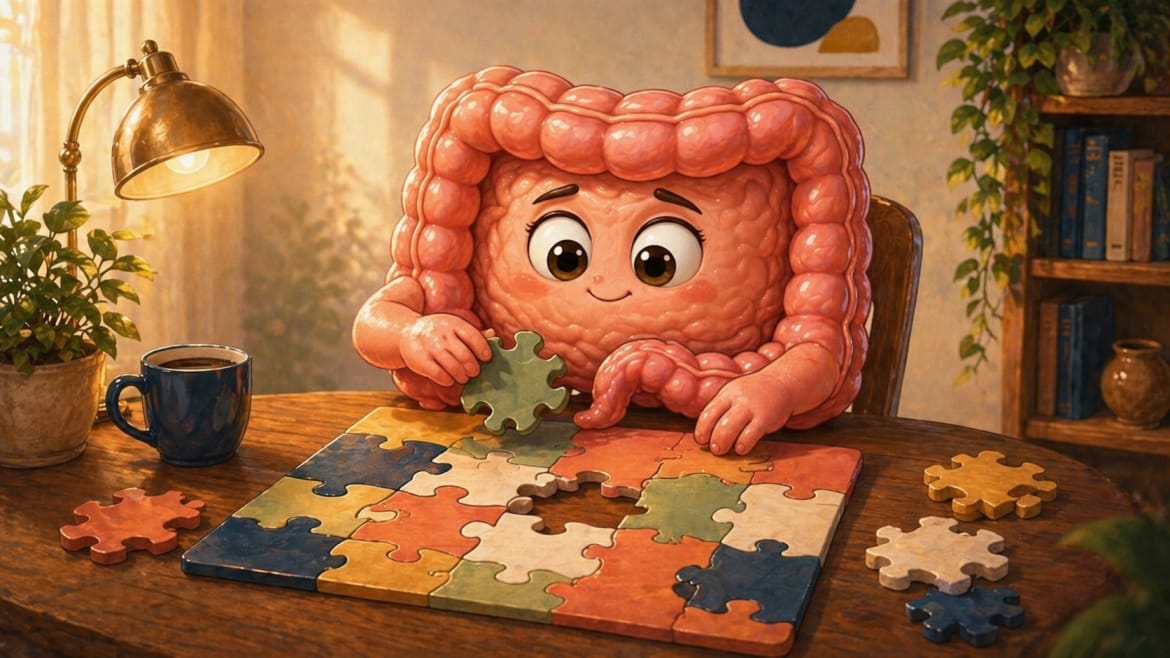
All of these factors can influence how the symptoms develop, and each of them is like a piece of a puzzle. If one is missing, you don't have a complete puzzle and there is a chance your symptoms won't fully recover. If you have all the pieces and know the order in which the puzzle needs to be put together, you can recover from the symptoms you have been told time and again you'll just have to learn to live with.
In our book ‘First Aid for Your Gut’, Jeroen explains step by step how your digestion works, what role your gut bacteria play and what you can do in practice to address the cause. Would you like to know what the make-up of your microbiome looks like, and whether a bacterial overgrowth, a fungal infection or a parasite plays a part in your symptoms? A stool test can map that out for you.
Perhaps it is time to see IBS not as the answer, but as the diagnosis that points the way to the next question and the next step.