

You're having trouble with your gut. Maybe you get gas, a bloated feeling, or stools that keep changing from one day to the next. The symptoms keep coming back, without you knowing exactly why. You've probably tried all sorts of things already: one diet after another, all kinds of supplements and probiotics, but you just can't get your gut under control.
What many people don't know is that the key often lies in a place almost no one looks: your gut flora. The huge community of bacteria that lives in your large intestine does far more for you than simply digest your food.
In this article I explain what your gut flora actually is, what it does for you, what happens when it falls out of balance, and why that can be an underlying cause of symptoms that keep returning. And most importantly: that there is a cause behind your gut symptoms, and that you can do something about it.
What your gut flora is
Your gut flora, also called your gut microbiome, is made up of an enormous number of bacteria that live mainly in your large intestine. We're talking about many millions of bacteria, spread across hundreds of different species. Together they form a complete ecosystem inside your belly.
What matters here is that the different species, and how many of each there are, stay in balance. The best way to picture your microbiome is as a self-sufficient village, far from any other village. That's exactly why it matters that the residents support one another. Everyone has their own job, and as long as every job gets done, the village thrives.
Something similar happens in your large intestine, only here it's an ecosystem at a bacterial level. Each group of bacteria needs to be present in the right amount to add to the whole. Simply by taking up the space, the good residents keep unwanted intruders small. A full and varied village leaves little room for anything that doesn't belong.
For many bacteria, we know the specific job they do within the ecosystem. A few of these species deserve to be named, because they make the difference between a gut that works well and a gut that causes symptoms.
Butyrate-producing bacteria
The first group are the butyrate-producing bacteria. Fibre from fruit and vegetables is something your own digestion can't break down, but these bacteria can. They ferment that fibre in your large intestine and make butyrate, also known as butyric acid. Butyrate matters for several processes. It is the main fuel for the cells of your gut wall. And perhaps even more importantly, it is the fuel for your gut flora itself, steering it in species and number so it stays balanced and strong. On top of that, butyrate has a positive effect on the NOD2 gene. In practice, that comes down to a calming, anti-inflammatory effect on the immune activity in the ileum, the junction between your small and large intestine. That is exactly the spot where people with Crohn's disease often have inflammation.
Akkermansia
Then there is Akkermansia. This bacterium plays an important role in maintaining and renewing the mucosa, the thin layer of mucus that sits on your gut wall. The mucus itself is made by your gut wall. Akkermansia lives in it, feeds on it, and in doing so keeps that layer renewing itself. This layer of mucus forms a safe zone between your body and everything that lives and moves inside your gut.
You can compare that safe zone to North and South Korea. On paper, these two countries have been at war for decades. Between them lies a wide strip that no one may enter without permission. That is what keeps things calm.
The mucosa does something similar. Inside your gut, all sorts of things live and move: the food you've eaten at different stages of digestion, good bacteria, bad bacteria, and all kinds of other substances that come in through eating or drinking. Your immune system keeps watch and has to decide what's safe to let through, and what should leave again with your stool.
The mucosa gives you a safe buffer, so your immune system isn't constantly in contact with all those substances. When the mucosa gets thinner, your immune system reacts more and more often, and the chance of a food intolerance or inflammation in your gut goes up.
Akkermansia also helps other good bacteria attach to the gut wall, so they stay in your gut instead of disappearing with every trip to the toilet.
Lactobacillus
The third group, Lactobacillus, keeps your immune system in check. A large part of your defence sits around your gut, and your gut bacteria are in constant conversation with it. They train it, they regulate it, and they make sure it doesn't overreact to harmless triggers. A healthy microbiome therefore makes you less prone to inflammation.
Low mood, depression, or constipation
And something else goes on that you only notice once the process runs less smoothly. About 95 per cent of your serotonin is made in your gut, under the influence of your microbiome. That substance is often called the happy hormone, because it plays a big part in how you feel. Serotonin also plays an important role in your gut's peristalsis: the squeezing motion your intestines use to move the food mass along, from your mouth right through to the other end. When your gut flora is disrupted, you can end up with constipation and feel low or depressed.
Not just bacteria: the fungi matter too
When we talk about your gut flora, most people think of bacteria. But among all those bacteria there is also a smaller group of fungi and yeasts. Small in number, and yet not unimportant. Candida is the best known of them, and in a healthy gut it simply belongs there.
Just like your bacteria, these fungi communicate with your immune system. As long as the balance is right, they help keep your immune system calm and well trained. But when that balance shifts, for example after a course of antibiotics or with a one-sided, sugar-rich diet, a yeast like Candida can take over. And then the opposite happens: instead of keeping your defences calm, an overgrowth switches your immune system on.
You won't always feel it in your belly straight away. But you can pick up signals on the toilet, because a Candida overgrowth can cause loose, mushy stools. Research links a fungal overgrowth to low-grade inflammation in the gut, to chronic bowel inflammation such as Crohn's disease and ulcerative colitis, and to allergic and autoimmune reactions. Because fungi are common and can have a major negative effect on your digestion and your overall health, it is important to rule out a fungus as an underlying cause of your gut complaints. That is why a stool test not only looks at your bacteria, but also at whether a fungus or yeast has overgrown.
How the balance gets disrupted
The balance of your gut flora is both powerful and fragile. In an ordinary situation, your gut flora can stay strong your whole life and work the way it should. Even so, there are a few things in life that can seriously disrupt it.
The first is your food. A one-sided diet, built mostly on processed products, plenty of sugar, and little fibre from fruit and vegetables, mainly feeds the wrong bacteria. The good species, the ones that depend on fibre, get too little to eat and drop in number.
The second is antibiotics. Ten to twenty years ago they were seen as a wonder cure: a course was prescribed for the most varied of complaints. Thankfully, the tide is turning. Because while antibiotics are sometimes necessary, they have a downside too.
Sometimes you get a specific course of antibiotics aimed at just one group of bacteria. That does little collateral damage. A broad course kills every bacterium it meets along the way. When you take antibiotics as a tablet, they reach your large intestine too, where they can disrupt your gut flora. If your symptoms linger after antibiotics, it's important to investigate the cause with a stool test, so you can rebuild your gut flora in a targeted way.
Third, there is stress. This has always been a survival mechanism. The moment you feel stress, more energy is sent to your arms and legs so you can fight or flee. Other systems, like your digestion, are turned down for a while. For a short spell that's no problem, but if you live under chronic stress, from a toxic relationship, money worries, or simply because you're missing important nutrients, the problem grows bigger and bigger over time.
When your digestion is running on a low setting, you digest your food less thoroughly, so undigested remnants end up in your large intestine. That gives the bacteria a different supply of food, and the make-up can shift.
For most people it isn't one event, but a build-up. A few courses of antibiotics in childhood, years of little fruit and vegetables, and a stretch of heavy stress. Bit by bit the diversity falls away, and slowly the symptoms begin: gas, a bloated feeling, or stools that keep changing in texture. That's why many people can't remember exactly when their symptoms started.
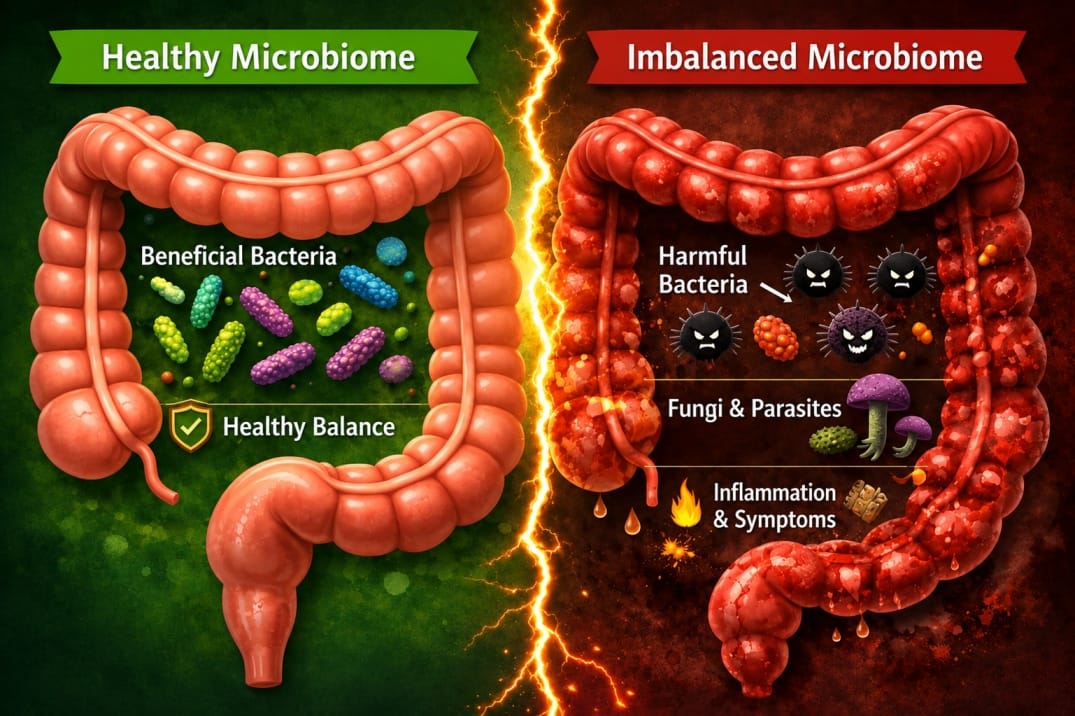
At the bottom of it, they all share one thing: when the good bacteria drop in number, that opens up space for unwanted guests. An overgrowth of the wrong bacteria, a fungus such as Candida, or even a parasite. Together we call these pathogens.
What then happens in your body
As soon as those pathogens take over, a lot changes. First, they disrupt your digestion, so you digest and absorb less of your food, while they get more undigested nutrients to feed on. But it goes further than that.
A disrupted gut flora makes less butyrate. That leaves your gut wall with less fuel, and the layer of mucus grows thinner. The barrier that protects your body becomes damaged and more permeable. And then something happens that you don't feel directly, but that explains a great deal.
Through that weakened gut wall, substances leak across that normally never get through. Small fragments of bacteria, known as LPS, and food particles that aren't fully digested, enter your body this way. Your immune system sees them as intruders and springs into action. Not because it's making a mistake, but because it's doing its job. The trouble is that this constant triggering doesn't stop as long as the cause stays in your gut. That's how a smouldering, low-grade inflammation sets in and keeps going, and it can even develop into chronic inflammation of your gut wall.
That same permeable gut wall, also called a leaky gut, explains why some people tolerate more and more foods poorly. This can also happen when your body is under stress. When food particles that aren't fully digested cross the gut wall, your immune system can flag them as dangerous and make antibodies against them. From that point on, your body reacts with urgency and loose stools to foods you could eat without any trouble before.
What once began as a gut problem now feels like a growing list of things you can no longer eat. With a food intolerance test, we can map out which foods your body reacts to.
Researchers are increasingly finding that this reaches beyond your gut alone. The make-up of your gut flora turns out to be linked to how well your body responds to insulin, the hormone that controls your blood sugar. That same leaky gut and low-grade inflammation also play a part in metabolic problems, right up to fatty liver, also known as non-alcoholic fatty liver disease, or NAFLD. So your gut flora doesn't stand on its own: it shapes your whole body.
What you notice from this
In practice, you often notice a disrupted gut flora through familiar symptoms. Gas, a bloated feeling, stomach pain, diarrhoea, or constipation. Symptoms that often get pushed under the umbrella of irritable bowel syndrome, without anyone looking at the underlying cause.
Maybe you recognise the pattern: you adjust your food and feel better for a while. After a while, the symptoms are back. When tests are run, you're told everything is normal and that you'll just have to learn to live with it. In truth, all that means, and this is an important nuance, is that the tests that were done found no detectable cause. That changes nothing about your symptoms: they are very much there, and they are real.
But it doesn't just stay in your belly. When your digestion is disrupted, you digest and absorb less of your food, which can lead to a shortage of important nutrients. Because of that, and because a low-grade inflammation costs energy and keeps your immune system switched on, many people often feel tired and drained, and catch colds more often and take longer to recover. You feel as if your body is letting you down, while the doctor can find nothing.
What many people don't know is that a disrupted gut flora can be an important underlying cause of their symptoms. And as long as that balance isn't restored, the symptoms tend to get worse over time. You can try to make the symptoms bearable or to suppress them, but as long as the cause sits in your gut, the real problem stays.
The good news: your gut flora can be restored
Let this be a glimmer of hope in your search. The fact that your microbiome has fallen out of balance doesn't mean there's nothing you can change. As you've read in this article, several factors are at play. The two you have the most influence over yourself are the stressors in your life and the food you eat each day. Because what you eat, the bacteria in your gut eat too.
To shift the make-up of your gut flora in the right direction, fibre from fruit and vegetables is hugely important. If you eat little of it now, build it up gently. The bacteria in your gut need the chance to move with a different supply of food. Bring it in through small portions, and steam the vegetables first, so they're easier to digest.
You can also look at fermented foods such as sauerkraut, kefir, and kimchi. It's one of the oldest ways to feed and replenish your gut bacteria. Here too, build it up gently.
While these dietary changes can have a positive effect, many people need a targeted treatment as well. When the gut flora is badly disrupted, or there's a parasite, fungus, or bacterial overgrowth present, that won't recover on a change of food alone. In that case a targeted approach is needed to restore your digestion, push back the pathogens, and rebuild your gut flora.
The most important step is knowing what's going on inside you. With a stool test, we map out the make-up of your microbiome. Our specialised lab looks at more than eighty measurements. That starts with the bacteria we covered at the beginning of this article: the ones that make butyrate, the ones that maintain the mucosa on your gut wall, and the ones that have a positive effect on your immune system. We look at whether there's a bacterial overgrowth, a fungus, or a parasite present, how active your immune system is in the gut, and how well your digestion is running.
In our practice, that points to a clear trigger in most cases, even for people who have searched for years without an answer. In the rest, a food intolerance or chronic stress is often at play.
Jeroen knows from his own experience how much difference it makes to understand what's really going on in your body. In 2015 he was diagnosed with Crohn's disease. In just six months he was free of the symptoms the specialist had called incurable. To share that knowledge and experience, he wrote the book 'First Aid for Your Gut'. In it, he explains step by step how your digestion works, what role your gut bacteria play, and what happens when that system is disrupted.
Would you like to know what's going on in your gut, and how to test your gut flora so you can restore it in a targeted way? Apply for an intro call. In thirty minutes we look at what you've already tried and whether our approach fits.