
In early 2014 I was prescribed a course of antibiotics for a fistula. The course lasted two weeks, but the fistula stayed. I was given a stronger course. Again, no result. That same year a third course followed for other symptoms. Three courses of antibiotics within one year. The first two didn't help, the third did work for what it was prescribed for. But I only noticed later what all three of them did to my gut.
In the months after that, my belly became unsettled, and out of nowhere I would feel a terribly painful stab in my belly. In the months that followed, those stabs came more and more often, until I had them almost every day and could no longer deny to myself that something was wrong.
What antibiotics do to your gut
Antibiotics kill bacteria. That is what they are meant for. Roughly speaking, there are two kinds of antibiotics. One kind kills a specific bacterium, and a more general kind tackles everything it comes across. The problem with that second kind is that it can't tell the difference between bacteria that make you ill and bacteria that keep you healthy.
Millions of bacteria live in your large intestine, working together as an ecosystem in which each of them has its own job. You can compare it to a small, remote village. When everyone does their job, the village can thrive. The same thing happens on a small scale in your gut, where some bacteria break down the fibre in your food. There are bacteria that help protect your gut wall, and others that support your immune system. When these bacteria are present in 'normal' types and numbers, everything in your gut runs the way it should.
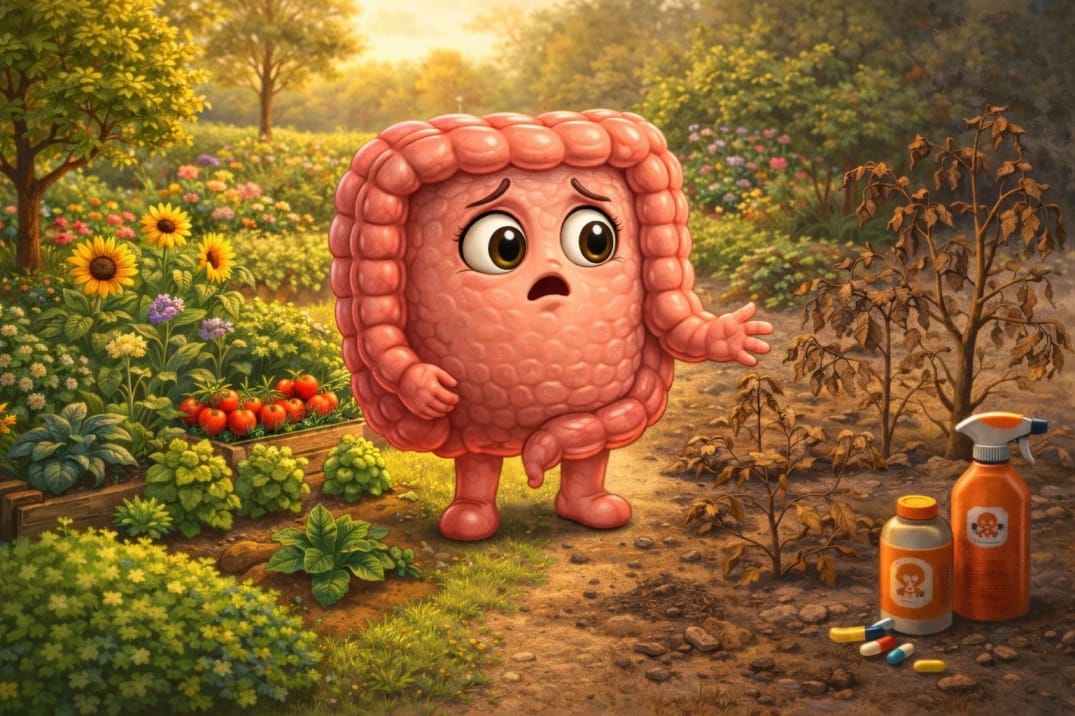
Now compare this with a garden you have carefully built up over many years. There are all kinds of plants, shrubs and trees, and there is even a vegetable patch with all kinds of vegetables growing together in balance. Antibiotics are like a weedkiller you spray over the whole garden. The weeds die, but so do your flowers and vegetables. What grows back afterwards is not necessarily what was there before. It is whatever can claim the space the fastest. And that is exactly what happens in your gut.
The signal I recognised too late
Looking back, I can see that my stools had not been formed the way they should be for years. 'Normal' stools are shaped like a firm brown banana. If your stools have the texture of chocolate mousse or are even thinner, you don't have 'normal' stools, and it is important to do something about it, so it doesn't get worse over time.
Although I had loose stools for years, I had no other symptoms at that point. The courses of antibiotics disrupted my microbiome further, and I regularly saw blood in my stools and, over time, also got the painful stabs in my belly.
What I didn't know then is that your gut flora doesn't recover on its own. Your gut needs the right nutrition, the right conditions and sometimes targeted support to rebuild that ecosystem. Occasionally, buying a bottle of probiotics and hoping for the best is enough, or at least helps. In many cases, a targeted approach is needed to rebuild the microbiome.
Does your gut flora recover on its own after a course?
That depends on your situation, on the course and on how many courses you have had. A strong gut flora that is in balance can take a knock. If that balance is already weaker and the environment in your gut has deteriorated, a course can be the final push that leaves it permanently disrupted. Like the garden: once the weeds get the upper hand, they take up more and more space.
Stool research shows what that looks like. In healthy men who were given a heavy combination of antibiotics for four days, the gut flora had largely returned after about one and a half to six months. Largely, because a number of species still had not come back after six months.
What sets the pace is how diverse your gut flora was beforehand, what you eat during and after the course, how much stress you experience, how you sleep, and whether it is just the one course. To rebuild, your gut flora needs the right conditions. That starts with how well your digestion itself works, and with feeding your bacteria fibre from fruit and vegetables. If you start eating more fibre, build it up slowly, so your bacteria can get used to the larger supply.
Does a probiotic help during or after the course?
Around a course of antibiotics, a probiotic makes sense more often than at other times. What we advise in our practice is to take a good-quality probiotic during the course, to limit the negative effect on your gut flora.
Take it at a different time of day from the antibiotics, so they don't arrive in your stomach and gut at the same moment. If the timing of your doses doesn't allow that, start straight after the course.
If the probiotic gives you symptoms, stop taking it straight away. If the texture and frequency of your stools don't recover by themselves after that, get tested to find out where the disruption comes from.
Does this sound like you?
If you developed symptoms after a course of antibiotics that just won't go away, there is a good chance your microbiome has fallen out of balance. That is not a rare problem. It is something we see very often at First Aid for Your Gut.
A scientific study shows that people diagnosed with Crohn's disease or ulcerative colitis were often prescribed antibiotics 2 to 5 years before their diagnosis. That doesn't mean antibiotics are the only cause, but it does show how big the impact on your gut can be.
When to see your GP after a course of antibiotics
Make an appointment with your GP if you notice any of these:
- severe watery diarrhoea during or shortly after the course
- blood or mucus in your stools
- fever with gut symptoms that persist
- weight loss when you are not dieting
- symptoms that last longer than a few weeks or clearly get worse
- symptoms that wake you up at night
Nothing found, and the symptoms persist? Then the tests have mainly told you what it isn't. The question of why your gut does what it does is still unanswered.
Would you like to know how your microbiome is made up and what exactly is going on in your gut? With a stool test we map out the make-up of your microbiome, so you don't have to guess but can see what is going on. On that page you can watch a video or read an article in which Jeroen explains what this test involves and what insights it gives you.
What would change if you knew what your gut needs?