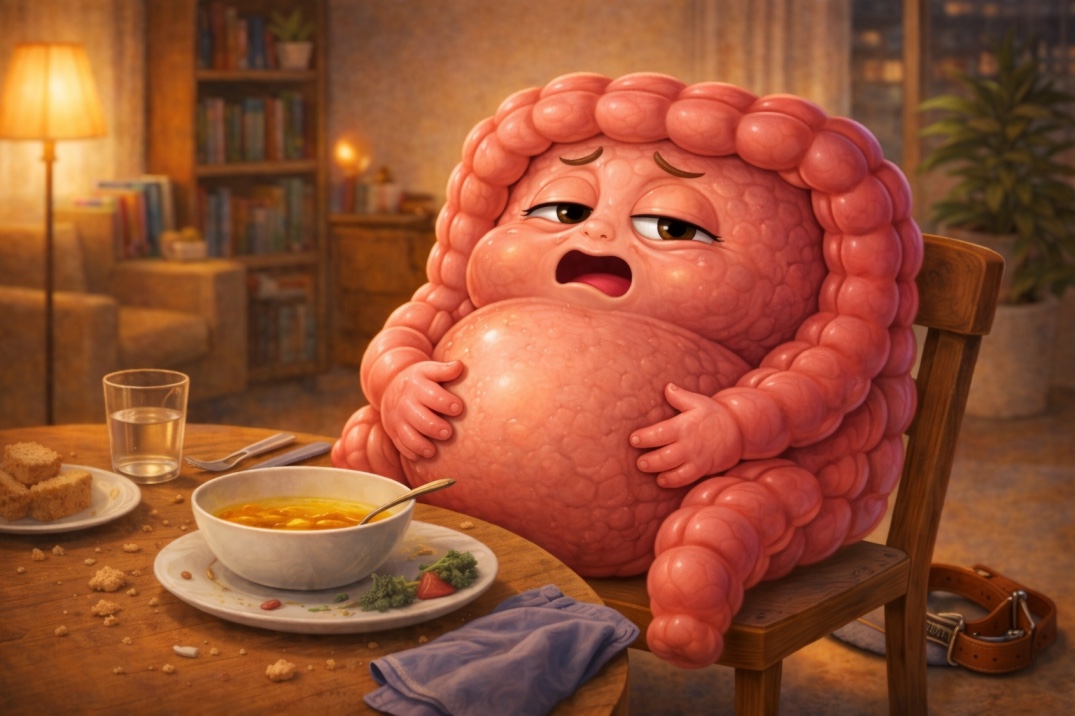
This morning, when you walked out the door, your trousers still felt fine. Now, halfway through the afternoon, you already have to undo the button. Your belly is swollen as if you have just finished a Christmas dinner, while all you had was a sandwich and a bowl of soup.
Bloating is one of the most common complaints we see in our practice. And at the same time, one with a big misunderstanding around it. Most people think it just comes with the territory, that it is down to certain foods, or that they simply have a sensitive gut. But a bloated belly is not normal. It is a signal.
What happens in your gut when your belly swells up
To understand where that bloated feeling comes from, you need to know how your digestion works. Everything you eat makes a journey through your body: from your mouth, through your stomach and small intestine, to your large intestine. Along the way, the meal you have eaten is broken down and absorbed. That sounds simple, but it is really a team effort between several organs that all have to do their job well.
Your stomach breaks food down with stomach acid. Your pancreas adds digestive enzymes that break down proteins, carbohydrates and fats. Your gallbladder delivers bile to emulsify fats, and a few more things happen so your gut can absorb the nutrients. If one of these steps falters, undigested food ends up in your large intestine. And that is where the problem starts.
Imagine you eat a piece of chicken that is not properly broken down and absorbed in your small intestine. The undigested protein ends up in your large intestine, where it sits for hours at a body temperature of 37 degrees.
Exactly the same thing happens when you leave meat out on the kitchen counter on a warm summer day: it starts to rot, and it produces gas. When this happens in your belly, those gases make your gut swell up. You feel pressure, you feel tension, and your belly visibly grows bigger. The little farts you cannot hide, they actually make sense once you know what is going on, because it is undigested protein you smell.
The problem is not the food, it is the digestion
A lot of people start avoiding certain foods when they notice their belly swells up from them. Bread, onion, garlic, beans, lentils and chickpeas. The list keeps getting longer. And yes, sometimes that gives temporary relief. But you do not solve the underlying problem. You avoid the foods that cause the symptoms, instead of looking at why you cannot digest them properly.
What I see with clients is that bloating almost never stands on its own. It often goes together with fatigue, changing stools, or the feeling that your belly stays full for hours after eating. Those are all signals that your digestion is not working well. And the cause can lie with your stomach acid, your pancreas, your gut bacteria, or a combination of these.
Understanding what is going on in your gut
Bloating is unpleasant, but it is also a signal. Your body is letting you know that something is not going right in your digestion. The only question is: what exactly?
In the book "First Aid for Your Gut" Jeroen explains step by step how your digestion works and what the most common disruptions are. For anyone who wants to look further, a stool test gives insight into what is concretely happening in your gut: how your microbiome is composed, whether your digestion is working well, and whether there are factors keeping the symptoms going.
What would change if you finally understood why your belly swells up?
Maybe personal guidance is something for you. This is where you learn what the cause of your gut symptoms is and what you can do to restore your health. Would you like to talk through your situation? Apply for an intro call. In thirty minutes we look together at what is going on for you and whether our approach fits.