
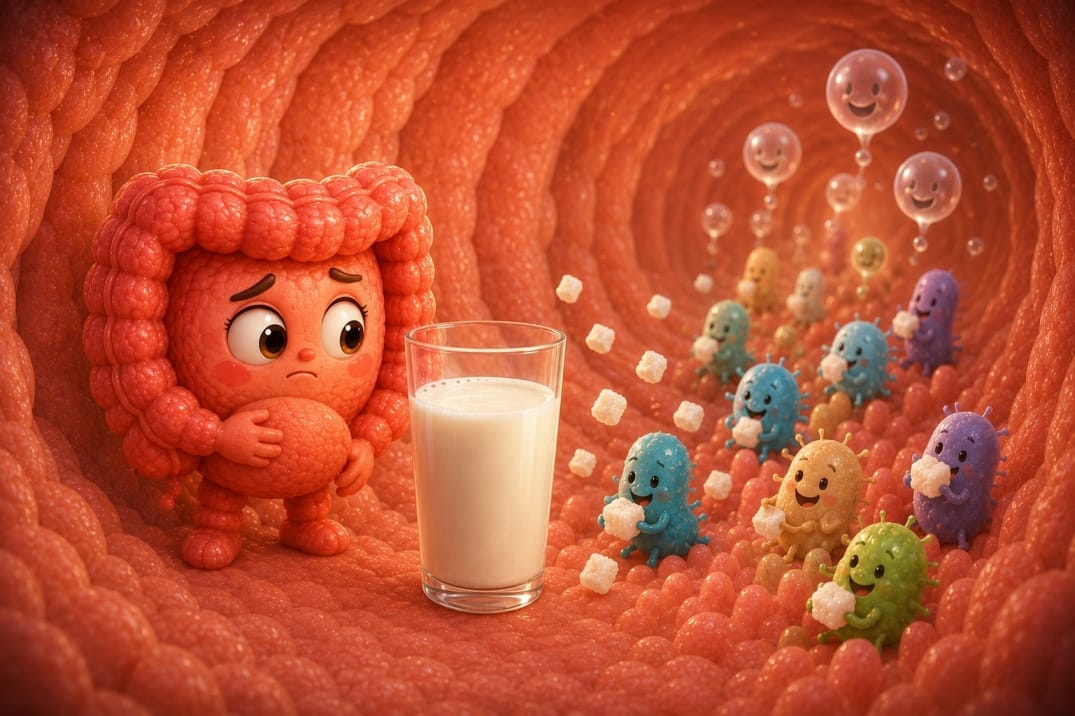
You're reacting to dairy more and more often. After a glass of milk, a cheese sandwich or a dessert, your belly starts to play up: bloating, cramps, gas and sometimes diarrhoea. Which brings you to the question: do I have a lactose intolerance?
Maybe you do. But the answer is less black and white than it seems, because there can be several reasons why you react to dairy, and which one it is determines the best way to deal with it.
What is lactose intolerance
Lactose is the sugar naturally found in milk and dairy. To digest it, your small intestine produces an enzyme called lactase, which breaks the milk sugar down into smaller sugars your body can absorb. If you don't make enough lactase, the lactose stays undigested and travels further down your gut.
The first symptoms, cramps and a bloated feeling, come from the undigested lactose drawing water into your small intestine. From there it reaches your large intestine, where your gut flora takes over: the millions of bacteria living there ferment it. That fermentation produces not just gases but also acids that irritate your gut wall. Together, the gas, the acids and the extra fluid speed up the passage through your gut, which starts contracting faster to push everything along. And because everything moves so quickly, your large intestine doesn't have time to reabsorb the fluid, leaving you with thin, watery stools. Symptoms can start within half an hour, or just as easily a few hours later.
How strong they are depends on how much lactose you take in and how your body responds. A dash of milk in your coffee causes few problems for most people; a large glass of milk or a bowl of ice cream, and you'll feel it much more.
One thing worth knowing: a lactose intolerance is not the same as a cow's milk allergy. With an allergy, your immune system reacts to the proteins in milk, which can be more severe and come on faster. With a lactose intolerance it comes down to the sugar, the enzyme that should break it down, and how your body handles the undigested lactose. Two different things, with a different approach.
Why you react to lactose
This is where it gets interesting, because there are several reasons your lactase can be low.
The first is evolutionary. It's normal for your gut to make less lactase after childhood. Milk is meant to feed the young of humans and animals so they can grow; once you're older, you move on to other foods. On top of that, we're the only creature on earth that keeps drinking another animal's milk long after we've outgrown our childhood and our need for it. In that sense, lactose intolerance isn't a defect, it's the rule.
Even so, not everyone is affected to the same degree. In Northwest Europe and Scandinavia, cow's milk has been part of the diet for thousands of years, and a genetic adaptation developed as a result. People of Northwest European descent can often still digest lactose well into adulthood, whereas that's much less common for people with Southern European, Asian or African roots. So if you have a Northwest European background and you suddenly start reacting to dairy as an adult anyway, a disrupted digestion is usually a more likely cause than the inherited form.
And that brings us to the second cause: a disrupted digestion. Lactase is produced by the cells lining your small intestine. If that gut wall gets damaged, say after a stomach bug, a course of antibiotics, a stretch of heavy stress or an inflammation, lactase production drops with it. You become lactose intolerant because your gut can't make the enzyme properly. And there's hope in that: as the gut recovers, your ability to digest lactose can return.
A gut parasite can be behind it too. A parasite like Dientamoeba fragilis upsets the balance in your gut and can damage the gut wall, which lowers lactase production. And the undigested sugars left behind are exactly what these unwelcome guests thrive on. So a parasite can be the reason you suddenly react to dairy.
There is more than lactose: casein and A1 versus A2
Lactose is often blamed as the only culprit, but that's not always the case. Cow's milk also contains casein, its main protein. One form of casein, the A1 type, releases a compound called BCM-7 as it's digested, and in sensitive people that can cause gut symptoms and irritation. Some people who think they can't handle lactose are in fact reacting to this A1 protein.
There's also milk that contains only the A2 type of casein, without that compound. A2 milk comes from Jersey cows, among others, and goat's and sheep's milk are naturally A2 as well. Some people tolerate these noticeably better than regular cow's milk. With Jersey milk, do check that it's pure, as it's often a mix of A1 and A2.
How do you know if you are lactose intolerant?
The clearest way to find out is a hydrogen breath test. Undigested lactose reaching your large intestine produces extra hydrogen in your breath, which can be measured. Another option is an elimination test: cut out dairy completely for a few weeks, see whether your symptoms ease, then carefully reintroduce it.
The mistake people often make is to look only at the lactose and not at the gut behind it. Because a test alone won't tell you why your lactase is low, and that's exactly what determines the best way forward.
What you can do about it
Lactose-free dairy can help. The lactose has already been removed, so the sugar no longer causes symptoms. Just bear in mind that it only removes the lactose, not the casein.
If you mainly react to the casein protein, A2 milk from Jersey cows, goat or sheep can make a difference. Fermented products like yoghurt and kefir are often better tolerated too, because the bacteria in them have already broken down some of the milk sugars for you.
Often, though, the best thing is simply to cut back on dairy. Plenty of people get gut symptoms from cow's milk and find they feel much better with less of it. Try two weeks to a month dairy-free and see how your body responds.
If you'd like an alternative, coconut yoghurt is a good option, but check the label: some versions are very high in fat and can cause symptoms for that reason, because you take in more fat than you can digest comfortably. The lower-fat versions sit fine with most people.
Look at the cause, not just the milk
Are you looking for ways to ease gut problems such as irritable bowel syndrome, Crohn's disease or ulcerative colitis? Then cutting back on or cutting out dairy can be a good step.
Keep in mind that with an irritated or damaged gut, it's not only milk sugars that become harder to digest. So is the digestion of proteins and fats, meaning you get less out of your food and, over time, may feel more and more symptoms or fatigue.
That's why we look not only at which milk you can still tolerate, but above all at what your gut and digestion need to recover. Want to know whether your symptoms really come from the dairy itself, or from something underneath it? In an intro call we look at where you're at, what you've already tried, what might be going on, and what it would take to put those symptoms behind you for good.