
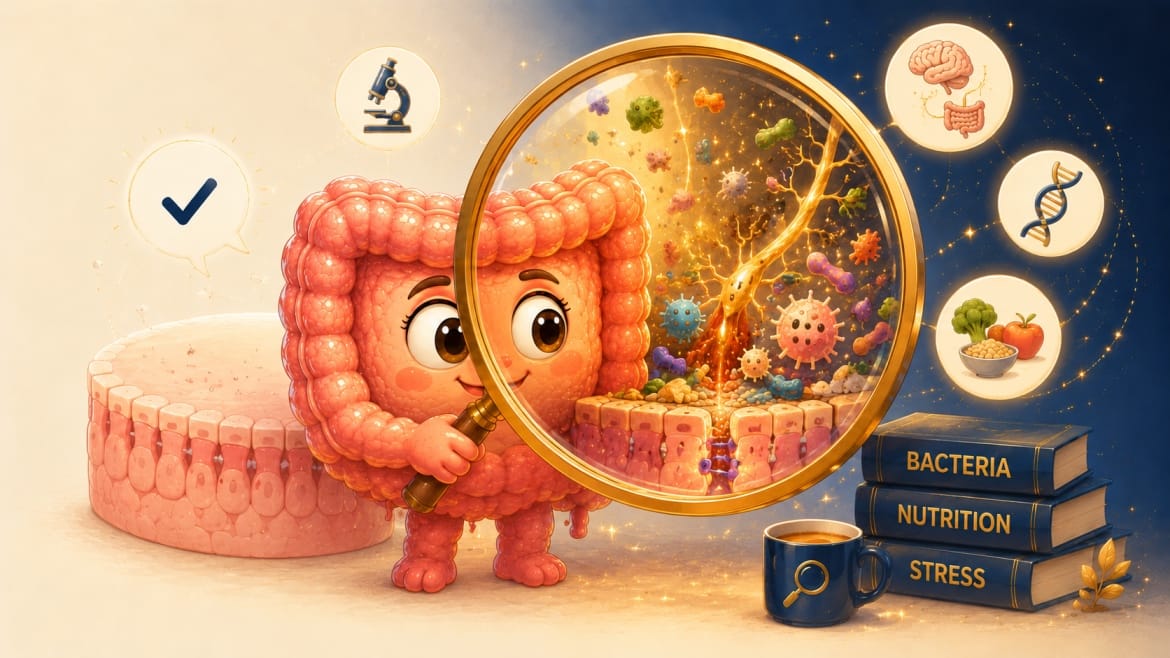
If you have gut issues, there's a good chance you've already been on quite a journey. Maybe you've had a colonoscopy, had blood tests done, or had an ultrasound of your abdomen. Each time you get the same result: 'we can't find anything abnormal' or 'you'll just have to learn to live with it'. Nobody can tell you what's really going on, and yet you feel the symptoms every day. You have gut issues, but no diagnosis.
It's understandable that you start to have doubts, and that it frustrates you.
Gut issues without a diagnosis don't mean that nothing is going on. They only mean that the tests done so far haven't yet shown the real cause of your symptoms.
Want insight into the possible causes that haven't been looked at so far, how they interact, and the first steps you can take yourself to ease your symptoms? Take the free Gut Scan.
Gut issues without a diagnosis: what standard tests do and don't measure
During a colonoscopy, a tiny camera is used to look at the inside of your gut: are there visible abnormalities such as inflammation, polyps or tumours? You could compare this test with examining your own hand. You can look at the surface of your skin, but you can't see what's going on beneath it.
When blood tests are done, they often look at inflammation markers such as calprotectin and CRP. If nothing shows up, the conclusion is quickly drawn that nothing is wrong.
That nothing was found is good news in itself: it rules out the serious conditions. But it doesn't get rid of your symptoms.
These tests only tell part of the story. More can be investigated, and that can give you new insights into the possible cause of your gut issues.
The factors that can play a part in unexplained gut issues
In our practice we guide people who come to us with exactly this story. All the standard tests have been done, nothing was found, but the symptoms are still there. When we then take a closer look, we almost always find a combination of factors that together can explain the symptoms.
We can use several tests for this. The first is a stool test, which looks at the composition of your gut microbiome. The second test that brings a lot of clarity is a food intolerance test. Together, these two tests almost always make the cause of the symptoms visible. We explain below why they matter.
Your gut flora
Your gut is home to millions of bacteria that together form your gut microbiome. In a healthy situation these bacteria work together: they help digest your food, and they produce vitamins, hormones and a substance called butyrate. Butyrate is the fuel for the microbiome. It helps keep the microbiome healthy in variety and numbers, and it helps protect your gut wall. Factors such as antibiotics, a one-sided diet or long-term stress can disrupt the balance of these bacteria.
This has a few important consequences. When the bacterial composition in your gut is disrupted, these processes run less smoothly, there's room for a bacterial overgrowth, a yeast or a parasite, and your digestion becomes less efficient, which can lead to both constipation and diarrhoea, along with gas or a bloated feeling.
None of these disruptions are visible during a standard colonoscopy or calprotectin test. They can, however, be investigated with a comprehensive stool test that measures more than eighty markers.
Food and digestion
And then there's the role of food. It's not only what you eat that matters, but also how well your body can digest and absorb it.
Take gluten as an example. Wheat contains a protein called gliadin, which can open up the connections between the cells of your gut wall. These connections (called tight junctions) can be compared to sliding doors that decide what your gut wall lets through into your body. When those sliding doors are open, food particles that haven't been fully digested can end up in your bloodstream. When your immune system comes across these 'intruders', it can label them as very dangerous and start producing antibodies. This is how food intolerances can develop, and your immune system starts reacting to food you used to eat without any problems.
You may be thinking: but if I don't have coeliac disease, surely I can just eat gluten? That's partly true. You don't need to have coeliac disease to be sensitive to the effects of gliadin on your gut wall. Together with other factors, such as a disrupted microbiome, chronic stress and an overloaded immune system, this can lead to you developing more and more food intolerances.
And there's something else. You can eat the best meals, but if your gut isn't working properly and you can't digest the meal well, you can only absorb part of it. As a result you absorb fewer nutrients, and deficiencies can develop. Those deficiencies can in turn cause or worsen symptoms, from fatigue and low mood to skin problems such as eczema.
Stress and your gut
Many people with gut issues notice that stress makes their symptoms worse. That's no coincidence. Your brain and your gut are directly connected through the vagus nerve. This is the nerve that carries the communication between the two. When your body experiences stress, it sends energy to your arms and legs so you can fight or flee. This also means that your digestion receives less energy: you produce less stomach acid, your digestive juices are held back and you digest your food less well.
The problem is that many people live in a state of constant stress without realising it. Sleep that's disrupted night after night, negative thoughts, a schedule that's packed minute by minute. Your body makes no distinction between a life-threatening situation and a busy working week. And when your stress system is switched on all the time, it doesn't just slow down your digestion, it can also make your gut wall more permeable. That's how stress reinforces the problems that were already there.
How these factors reinforce each other
What I've learned over the past years is that gut issues rarely come down to a single cause. What you almost always see is an interplay between different factors that reinforce each other.
Say your gut wall becomes more permeable. This is also called a leaky gut. It can be caused by chronic stress, a lack of important nutrients or a disrupted microbiome. Then it's only a matter of time before food particles that haven't been fully digested pass through your gut wall into your bloodstream.
Your immune system notices these food particles. Under certain conditions it will produce antibodies against these 'intruders' more quickly, and it can even react with inflammation. When that inflammation develops in the gut wall, selective absorption decreases and the immune system reacts even more sharply because of the inflammation that's present. As a result, more and more foods can be rejected, causing diarrhoea. This gives your body less and less chance to digest your food and absorb the nutrients, so your energy levels drop, your immune system comes under even more strain and your stress system becomes even more active. And that stress, in turn, slows your digestion down even further.
This creates a downward spiral in which you slowly experience more and more symptoms and can eat less and less without problems.
What you can do
With this article I want to show you that much more is possible than you've been told, and than has been investigated so far. A comprehensive stool test gives you insight into the composition of the bacteria in your gut: whether there's an overgrowth, a yeast or a parasite, and how well your digestion and immune system are working. A food intolerance test shows which foods your immune system reacts to, so you know what's better to avoid for now because it unsettles your gut, and what you can keep eating.
Every one of our therapists has personal experience with gut issues. We know what it's like to live with symptoms that regular healthcare had no answer for, but in ourselves and in the people we guide, we also see how much recovery is possible when you address the right factors.
Want to know more? In the book 'First Aid for Your Gut', Jeroen explains step by step which factors play a part and what you can do about them yourself.
Would you like our guidance in restoring your health? Apply for an intro call. In thirty minutes we look at where you stand, what you've already tried and whether our approach is right for you.