
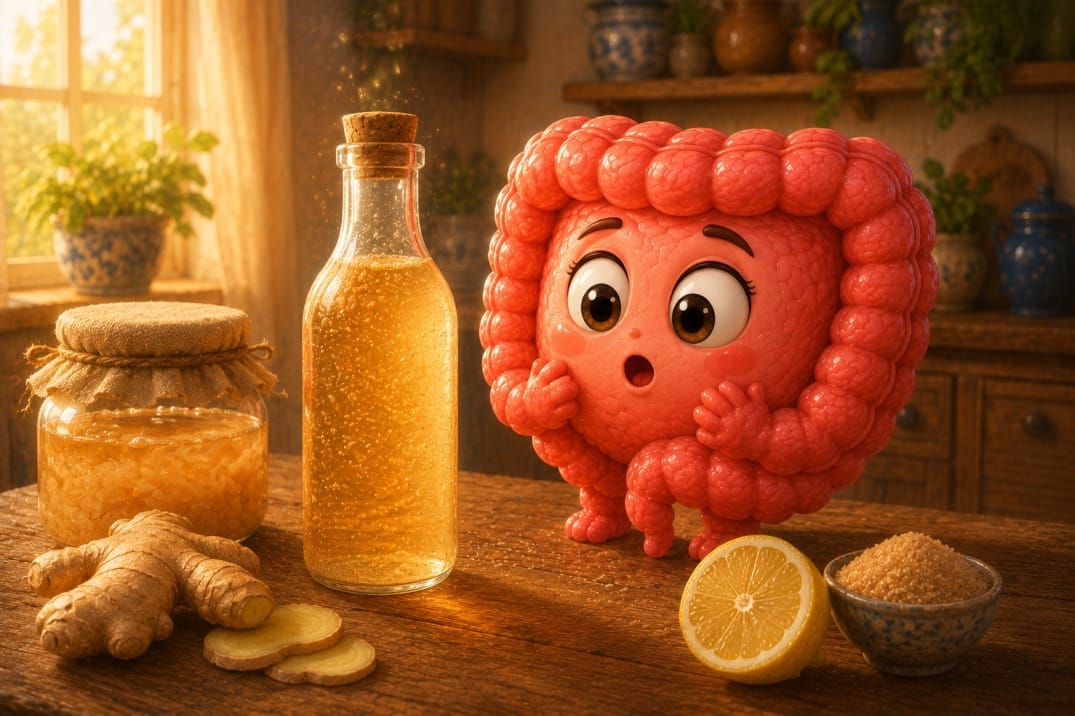
Despite its name, the ginger beer plant isn't a plant at all, but a remarkable symbiotic culture of yeast and bacteria. With sugar, water and ginger you use it to make a fresh, lightly sparkling ginger beer. And the culture simply keeps growing.
The ginger beer plant is an anaerobic starter culture for ginger beer: a naturally occurring, self-propagating organism that resembles a jelly-like lichen. It isn't a plant in the botanical sense, but a partnership between micro-organisms.
The culture is made up of a primary yeast, known as Saccharomyces pyriformis, and a primary bacterium, Brevibacterium vermiforme, now classified as Lactobacillus hilgardii. Together they set off the fermentation of a sugar solution with ginger added, and turn it into a sour, sparkling drink with a pleasant gingery aroma: ginger beer.
Where does the ginger beer plant come from?
The exact origin of the ginger beer plant is a puzzle. It's thought the culture comes from the Caucasus and was brought to England during the Crimean War. From the nineteenth century onwards it was used there to brew ginger beer at home, long before manufactured soft drinks took over the market. The scientific description of the culture goes back to the end of the nineteenth century, when researchers first mapped out the yeast and the bacterium.
How does the ginger beer plant work?
The ginger beer plant consists of grains of varying size, which multiply as long as you feed them with sugar and ginger. During fermentation the yeast produces carbon dioxide, which gives the natural fizz, while the bacterium provides the fresh, sour note. The interplay of the two is what sets it apart from an ordinary, artificially carbonated soft drink: here the fizz forms naturally.
How to make ginger beer
The basic principle is simple and needs little: sugar, water, ginger and the culture itself.
- Feed the culture daily with a little sugar and grated or ground ginger.
- Let the fermentation run at room temperature, closed off from too much air.
- After a few days, strain off the liquid, add lemon juice and sugar syrup to taste and bottle it.
- Keep some of the grains back as a starter for the next batch.
Take care when bottling: the ongoing fermentation builds up pressure inside the bottle. Use bottles that can withstand it and don't leave them standing too long or too warm.
A culture that keeps growing
As with yoghurt and sourdough, the rule is: treat the ginger beer plant well and it stays alive and grows along with you. You only need to bring a healthy culture into your home once to brew ginger beer with it again and again.
Is ginger beer good for your gut?
Whether ginger beer suits you too varies from person to person. Ginger can actually calm digestion, but watch out for the sugar, the carbonation and the naturally present histamine, which sensitive guts can react to. Our guide to fermented foods and your gut flora covers what to look out for when working out whether it's right for you.
Would you like our guidance in recovering from your gut symptoms? Apply for an intro call. The call lasts 30 minutes: we look at where you stand, what you've tried, and whether our guidance is a good fit. You'll always take something away from it.