Did you know a specialised stool test can reveal a great deal about your digestion?
Request the testYour digestion plays a crucial role in your health. It breaks the food you eat down into usable building blocks such as vitamins, minerals, proteins and fats, so your body can absorb and use them. This process is essential to supply your body with the nutrients it needs.
On this page you will find detailed information about stool testing and what it can tell you about your digestion. Below you can watch the video in which Jeroen explains what we test for and why. Prefer to read? Then use the menu below to jump straight to the topic that interests you.
When your digestion does not work well, it becomes harder for your body to absorb nutrients from your food. Over time this can lead to deficiencies, which can cause all sorts of symptoms and health problems.
The first signs are often subtle: your hair becomes dull and brittle, or your nails tear more easily. You might catch a cold that won't go away, get sick more often, or feel low on energy all the time.
These symptoms can arise because you are not getting the right nutrients, simply because you do not eat them, or because your body cannot properly digest and absorb them.
In the analysis we look at diversity: are there enough different types of bacteria in your gut, and how are the numbers of these types doing? In the example it is too low.

We also examine dysbiosis: how many bacteria are present in insufficient numbers, and is there bacterial overgrowth, fungi or a parasite? In the example, the dysbiosis index of 39 is very high. It should be as low as possible.

Countless bacteria live in your gut and together form the microbiome, also known as the gut flora. You can think of the microbiome as a remote village. In this village every resident has a specific job. As long as everyone does their work, the village stays self-sufficient. The same happens at a bacterial level in the microbiome: different bacteria each have their own role.
As long as there is enough diversity, meaning enough different types of bacteria doing their job and present in sufficient numbers, your digestion works as it should.
Factors such as antibiotics, stress and a one-sided diet can disrupt the make-up of the microbiome. As a result, not all tasks are carried out anymore, which can lead to symptoms such as diarrhoea, constipation and even inflammation.
Lactobacillus
Scientific research shows that Lactobacillus plays a crucial role in regulating your immune system. In people with Crohn's disease and ulcerative colitis, levels of Lactobacillus are often too low, especially during periods of active inflammation.

Clostridia
Clostridia is a group of bacteria that naturally occurs in your gut. An overgrowth, as shown in this test, can however cause symptoms such as diarrhoea, nausea, belly pain, cramps and sometimes fever.

Butyrate-producing bacteria
There are bacteria in your gut flora that can produce butyrate, also known as butyric acid. Butyrate acts as an energy source for these bacteria and plays an important role in keeping the microbiome healthy. The total bacterial count indicates whether these bacteria can produce enough butyrate. When this value is too low, your microbiome cannot produce enough butyrate.
These bacteria make butyrate from the fibre in vegetables and fruit. This process not only feeds the bacteria themselves, but also encourages the microbiome to produce more good bacteria and increase their numbers.
In this way these bacteria contribute to healthy digestion, help regulate your immune system, and help reduce inflammation in the gut. This is very important, especially for people with chronic gut diseases such as Crohn's disease and ulcerative colitis.
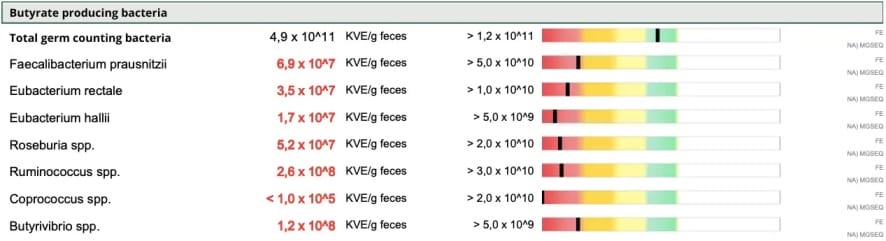
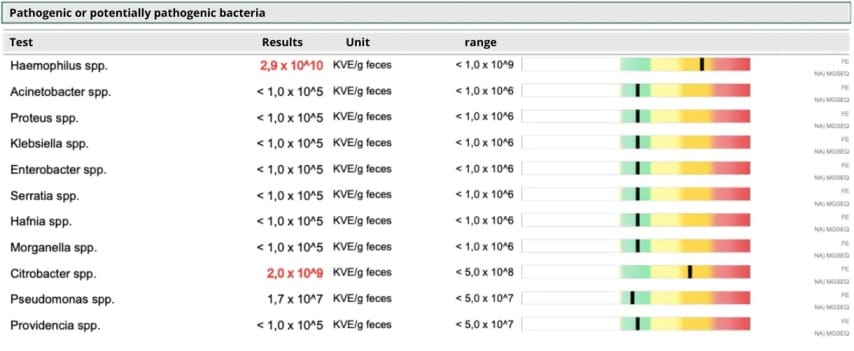
When certain bacteria are present in excess, we speak of an overgrowth, or pathogenic bacteria. In this case the test shows that both Haemophilus and Citrobacter are overgrown. This can lead to symptoms such as diarrhoea, belly pain and even inflammation in the gut.
Candida
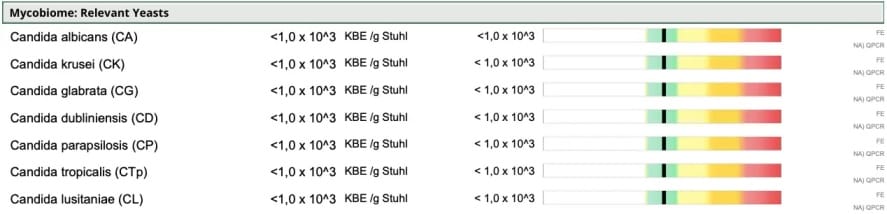
Candida is a yeast that naturally occurs in your gut. When it overgrows it can cause various symptoms such as bloating, gas, loose stools, a white coating on the tongue, fungal nails and, in women, a white vaginal discharge.
Parasites
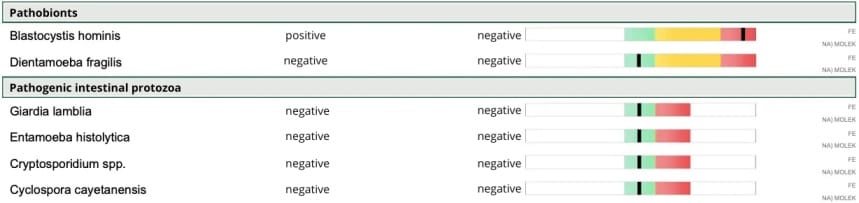
Some gut issues can be caused by parasites, microscopically small organisms that live in your gut. Parasites such as Blastocystis hominis, Dientamoeba fragilis and Giardia lamblia can cause symptoms such as belly pain, diarrhoea, gas and bloating.
What makes parasites extra tricky is that they live in cycles. Many people notice a recognisable pattern: usually they have good stools, but every so often there is suddenly an urgent need followed by loose stools. This can come with an unsettled belly, low energy and even a foggy or low mood.
If you recognise this, note in your phone when these symptoms occur. Over time you may discover a cycle of a certain number of days, in which good days alternate with days of urgent need and loose stools. If this pattern keeps returning, there is a good chance a parasite is the cause.
A stool test can detect these parasites, so it becomes clear what is happening in your gut and which treatment is needed to resolve your symptoms.
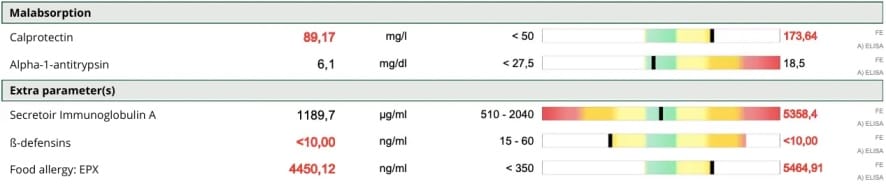
Your stool gives valuable information about the activity of your immune system and what is happening in your gut.
Among other things, we look at calprotectin, secretory IgA (sIgA) and beta-defensin. Calprotectin is a marker often used in conventional care to check whether there is active inflammation in the gut. Alongside calprotectin, sIgA and beta-defensin also give important insights into how active your immune system is in your gut. An active immune system is like an army being called up; it signals that something is going on.
We also test EPX, a marker that shows whether your body reacts to certain proteins, as with a food intolerance.
Can you actually digest what you eat? When digestion is disrupted, nutrients are sometimes not fully absorbed by your body.
In this test we see raised fat and sugar values in the stool. If these values are persistently raised, it can point to a problem in the digestion.
A raised sugar level can mean you eat more fruit or dairy than your body can digest. A raised fat level shows that fats are not fully digested. These signals give valuable insight into how well your digestion is working.

Your GP can have your stool tested. It looks for something different. Conventional care looks for blood, for inflammation markers such as calprotectin, and with ongoing diarrhoea for an infection. That test answers the question of whether something is acutely wrong. If nothing comes out of it, that is usually where it stops.
We look at the make-up of your gut flora, at bacterial overgrowth, fungi or parasites. At your digestion, and at the activity of your immune system in the gut. That tells you how your gut is functioning and what is going on inside it, so it becomes clear whether these factors are contributing to your gut symptoms. You do not need a referral for our test.
You request the test online, or as part of your guidance programme, and the test kit arrives at your home. The kit has everything you need, with instructions you follow step by step. You take the stool sample at home and send it to the laboratory.
Your results are ready within fourteen working days, and we go through them in your consultation. So you do not only know the result, but also what it means for your situation and what you can do with it.
The stool test always comes with a consultation, so you do not only get the result but also know what it means for you:

If you choose an online session of up to 90 minutes with one of our therapists, we discuss your results, connect the values to your story, and together we look at the next steps that suit you best.
Apply for an intro callThis is the price as it applies in the Netherlands. Depending on where you are, a different rate and different shipping costs can apply. We are happy to work that out for you once we know what you need.
We use these tests within our guidance programmes. The lab fee is fixed, but shipping and handling depend on where you live. The lab needs to process your sample within 48 hours, so it is returned by express courier, and customs rules for medical samples differ from country to country.
We currently work with a lab in Germany and the UK. When you are located outside of Europe, we'll look for a suitable partner based on your location. Apply for an intro call and we'll go through what is possible for you.